Independence
If we have two events A and B, the they are independent if . Now for 3 events A, B and C are independent if
This is true for any number of events.
Newton-Pepys problem
We have a fair six sided dice, then which of the following is most likely ?
A. at least one 6 with 6 dice.
B. at least two 6’s with 12 dice.
C. at least three 6’s with 18 dice.
Solution :
In general if we want to have at least k six’s with n dice there we can use the binomial probability of the form
Conditional Probability
Definition :
Intuition : Pebble world
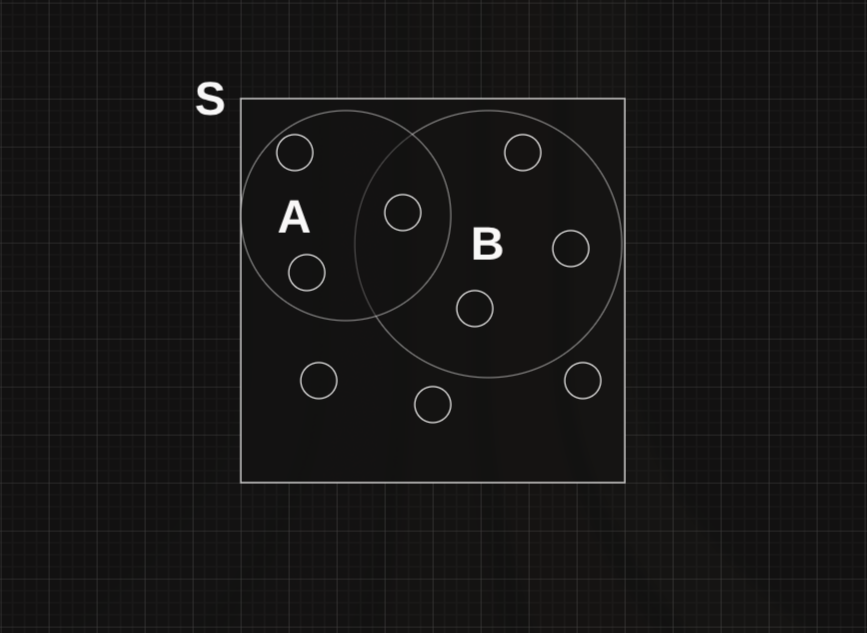
There are a total of 9 pebbles in the sample space. For ordinary probability of an A it is
When we have to find , we are saying that assume we already know that B happened. This means throw away all pebbles outside B. The remaining pebbles are the only possibilities left. Since probabilities must still add up to 1, renormalize the probability mass over the surviving pebbles.
So the new universe becomes just the circle B/
Now the question becomes: Among the pebbles that survived inside , what fraction are also in ?
That is,
In this case we get
Theorems
-
-
-
. This is also known as
Bayes Rule